A reading nook doesn't need a spare room or a bay window. It needs a chair you sink into, light that doesn't fight your eyes, and somewhere to put a mug. The best ones take up less floor space than a sofa, and they're often built from things you already own or could pick up second-hand. Here's how to plan, furnish and finish a corner that works even in the smallest living room.
Start with the measurements, not the chair
Before you look at a single chair, work out what space you have. In a small living room the corner is usually already taken: a floor lamp, a pile of ironing, a printer. The first job is deciding what moves.
You need roughly:
- 70–80 cm of width for a compact armchair, with a few centimetres either side so it doesn't look wedged in.
- 60–75 cm of clear walkway in front, so nobody has to shuffle past.
- A gap of at least 10 cm behind it if it sits near a radiator.
- Enough room for the door to open, or a drawer to pull out.
Mark the outline on the floor with masking tape and live with it for a day. It sounds fussy and takes five minutes, and it saves you from buying a chair that turns a usable room into an obstacle course. If nothing fits, look for a shallower chair rather than a narrower one: depth is what makes a corner feel crowded.
Choose an armchair that suits the corner
Depth matters more than width. A chair 70 cm wide and 75 cm deep will feel far lighter in a small room than one 65 cm wide and 90 cm deep, because you're buying back floor space in the middle of the room, where you notice it most.
Useful shapes:
- Slipper and accent chairs — low or no arms, so they slot into tight corners and keep sightlines clear.
- Swivel chairs — a smaller footprint than you'd expect, and one chair can do two jobs: reading, then turning to join the room.
- Wing chairs — enclosing and excellent for reading, but check the depth before you commit.
- Recliners — measure the open position, not the closed one, and leave room for it to extend.
Sit in it properly if you can, feet flat, back against the cushion. A seat height of around 45 cm suits most adults; if you're tall, look for a deeper seat, and if you're short, avoid anything so deep that your legs dangle. On fabric, a tight weave in a mid or dark tone hides everyday wear better than a pale linen — worth remembering if the chair will double as a landing pad for the whole household.
Layer in throws and cushions
A chair on its own reads as furniture. A chair with a throw draped over it reads as an invitation. That's the whole trick, and it costs very little.
Drape a throw over one arm and across the back rather than folding it into a neat square; it takes up less visual space and looks less staged. Waffle cotton, brushed cotton and lambswool all work well, and a wool mix stays warm without feeling heavy in summer. One throw and two cushions is usually plenty in a small corner.
Think about function, too. A firm cushion at the base of your spine makes a generously proportioned chair comfortable for long sessions, and a softer one under your arm supports your elbow while you hold a book. Keep the overflow in a basket beside the chair so the corner can be reset in seconds.
Keep to three textures
Aim for something smooth (wood, ceramic, leather), something soft (the throw) and something with a bit of grip (a woven rug, a chunky knit). Small rooms respond well to a limited palette, so pick two or three colours and repeat them across the chair, cushion and lamp shade.
Light it warmly, and low
Overhead light is the enemy of a reading nook. It flattens the corner, throws shadows over the page and makes the rest of the room feel like an office. You want a pool of light at shoulder height, not a flood from the ceiling.
A floor lamp with an adjustable arm is the simplest solution, because you can angle it over your shoulder without moving the chair. A table lamp on a side table works just as well, as long as the shade sits roughly at eye level when you're seated — too high and it glares, too low and it lights your knees. Warm white bulbs (around 2700K) are easier on the eyes at night than cool white, and a shade in linen or paper softens the light without swallowing it.
If you read on a tablet or e-reader, don't rely on the screen alone. A small pool of ambient light reduces the contrast between page and room, which is what makes late-night reading tiring. A dimmable bulb is worth the extra few pounds; you can turn it up for a puzzle or down for a chapter before bed.
Add a side table that earns its place
In a small room, every surface has to do at least two jobs. A side table should hold a mug, a book, a pair of glasses and perhaps a small lamp — and then get out of the way. Round tables take up less visual space than square ones, and a three-legged design is stable on uneven floors without a bulky base.
If floor space is really tight, look at:
- C-shaped tables — the base slides under the chair, so the top sits over your lap without blocking the walkway.
- Nesting tables — one for the mug, one for the book, and they tuck together when you're done.
- Wall-mounted shelves — a slim ledge at elbow height, fixed to the wall, keeps the floor completely clear.
- Stacked books or a sturdy stool — free, flexible and easy to move when guests arrive.
Whichever you choose, keep the top almost empty. A cluttered side table makes a small corner feel cramped, and you need somewhere to put your mug down without moving three ornaments first.
Make it work in a shared living room
A reading nook in a small living room is rarely private. The television is on, someone is on a call, and the front door opens straight into the room. You don't need to build a wall; you need a few signals that tell everyone this corner is in use.
Noise-cancelling headphones or a pair of simple earplugs are the most effective upgrade you can make. A thick rug and a heavy throw also absorb some of the hard sound that bounces off bare floors and walls. If you want a visual boundary, a folding screen, a tall plant or a slim bookcase can separate the nook from the rest of the room without stealing much floor space.
It helps to choose a time as well as a place. Half an hour before the household wakes up, or twenty minutes after the television goes off, gives you a reliable slot without asking anyone else to change their evening. The nook doesn't have to be quiet all day; it just has to be yours when you use it.
None of this requires a renovation. Move what's in the corner, tape out the footprint, choose a chair that's shallow rather than wide, and give it warm light at shoulder height. Add a throw, a cushion, a small table and a basket for the overflow. The result is a corner that costs less than a sofa and gets used far more often — and in a small living room, that's the best kind of furniture.
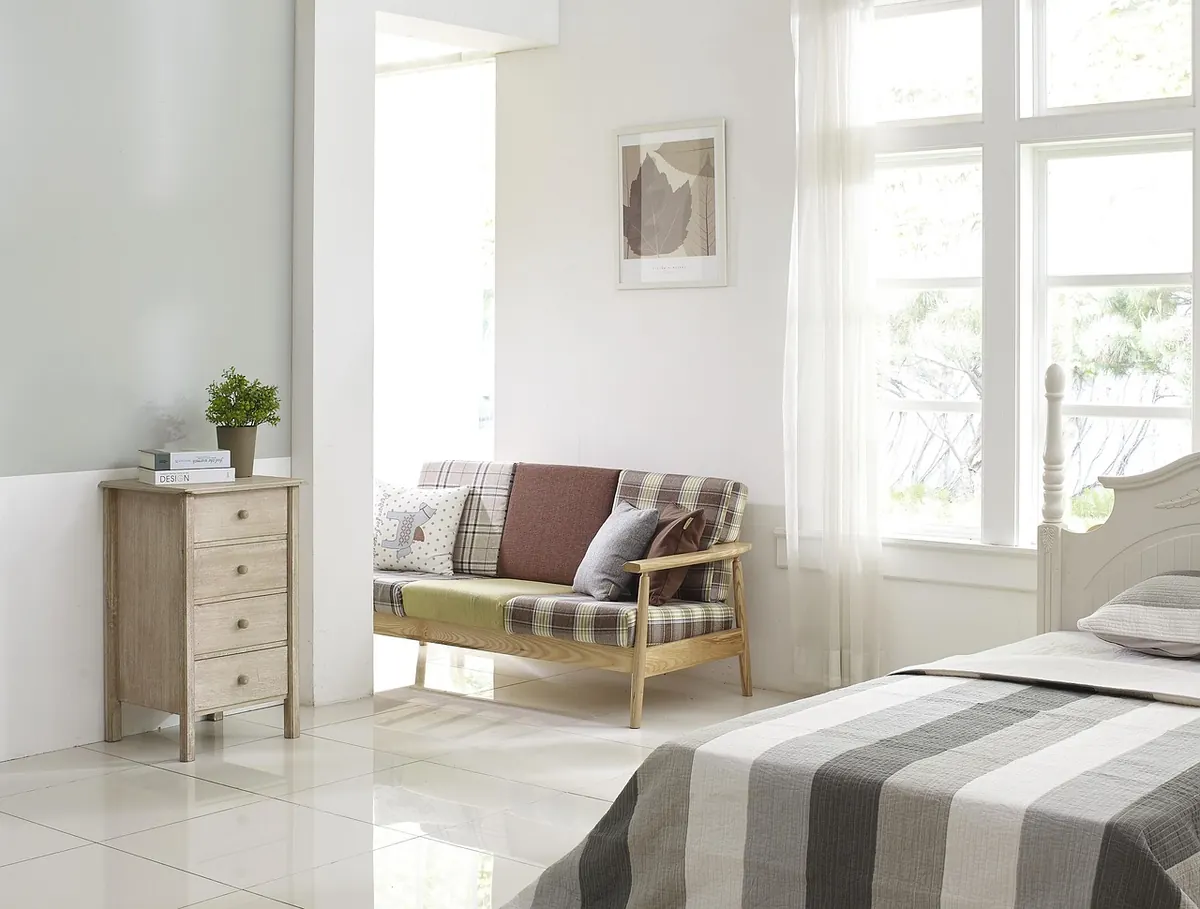
Photo: Hermann / Pixabay